Not All Plastics are Equal: Inside Our Material Testing Process
Our collection network pulls in up to 12 tonnes of plastic across the Lamu Archipelago. That's the part of our work that's easiest to picture, community members bringing plastic in for weighing, nets full of bottles, sacks of sorted plastic, our barge crossing the channel weighed down with up to 3 tonnes of plastic at a time.
But collecting plastic is only the beginning of the work. Plastic isn't one standard material. It’s dozens of different polymers with different melting points, different strengths, and different ways it breaks or deforms permanently under stress, environmental exposure, or time. Added to this that the material changes over time depending on its usage, age and where we found it. For instance, a fishing net and a water bottle are "plastic," but they behave nothing alike under heat or pressure. Treat them the same and you get a process that half-works for everything and fully works for nothing. Ship them off unsorted and undifferentiated, and you've shipped out the value of that material completely.
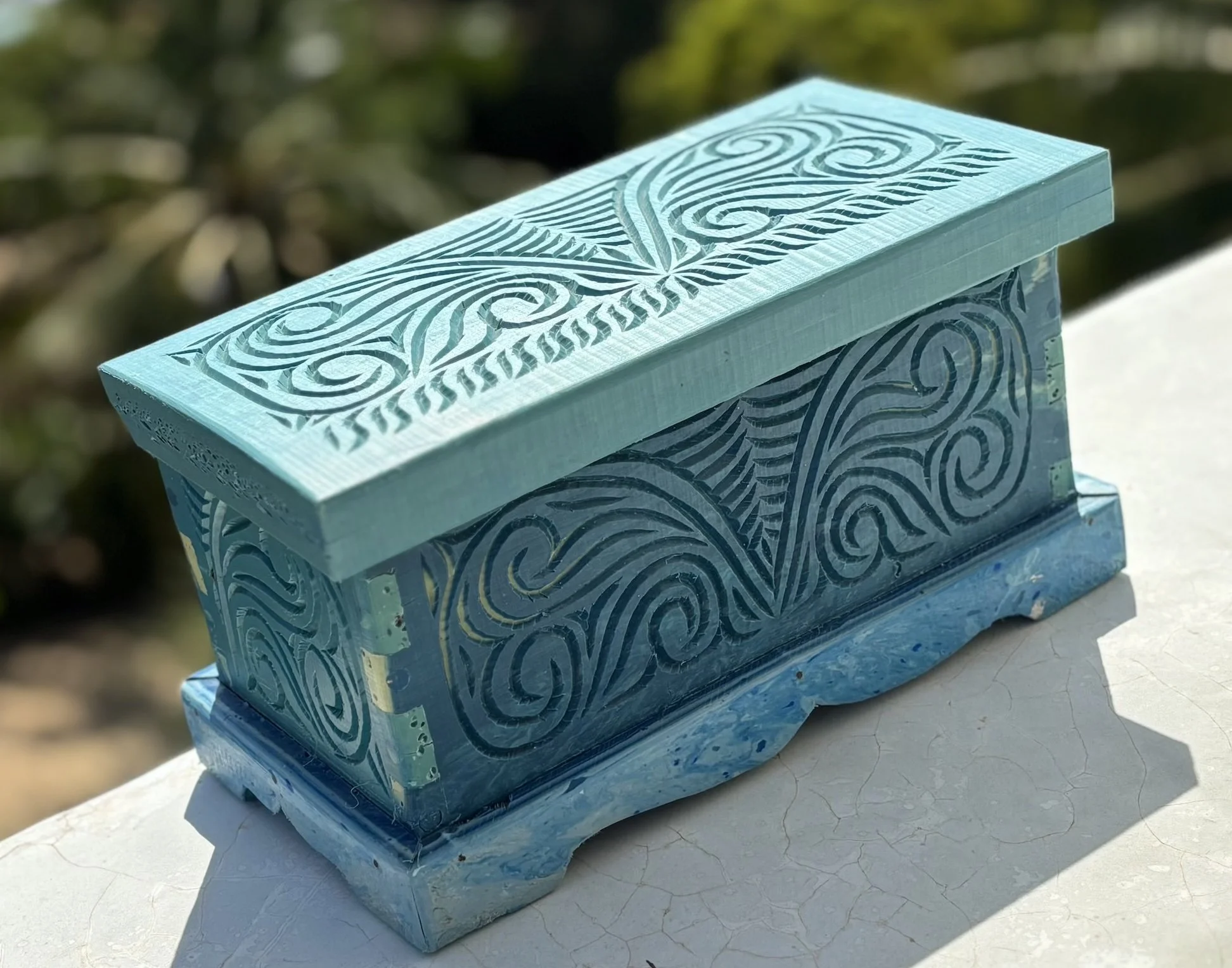
On of our Flipflopi Designs Jewellery boxes made from recycled HDPE.
That's why we’re continuously working on material research and development (R&D). This means trying to identify every polymer type that comes through our Materials Recovery Facility (MRF) and documenting the recycling process specific to that material, so we can work towards streamlining and improving our manufacturing efficiencies and capabilities. Without diligence, the end products would likely be compromised in terms of their quality and durability. It’s not difficult to make a fence pole from recycled plastic, but it is difficult to assure its lifetime usability.
As part of our commitment to circular economy principles we’re striving to ensure a high quality long lasting products that can be made locally under specific environmental conditions, and to build that knowledge and experience into standard operating procedures that can guide other remote and peri-urban communities.
What we already know works
Before we share what’s still being figured out we want to tell you what we do actually know. Since we started production, two materials have been in continuous, high-volume production allowing us to launch our furniture line Flipflopi Designs and create durable building materials such as fence posts and decking.
HDPE and LDPE have been our primary boatbuilding lumber since our very first dhow. It has better UV resistance, flexibility and impact resistance that a boat sitting in equatorial sun and salt water needs while also allowing us to create vibrant coloured lumbers that has become a defining element of our identity in our Swahili furniture (consider it spicing up the food which Swahili cuisine is so renowned for).
Polypropylene took us longer to figure out. Early PP lumber had big air pockets, brittle joints, and surfaces that cracked and chipped under the carving knife. But we knew the potential of this material so our production team spent time testing colour batches, mould settings and joinery redesigns until we had a consistent, satisfactory extrusion process for our lumber line. We can use the PP lumbers where it’s not necessary to take a heavy structural load or flexibility, like tabletops and fencing posts, because that's where its properties hold up.
None of this has come without real, ongoing challenges, even with materials we now consider proven. In Europe, PP is often held up as one of the easiest plastics to recycle. Yet that hasn't been our experience. The PP we recover locally tends to be more brittle and doesn't bind together the way the material is supposed to, which is why it took so many rounds of testing to arrive at a version we trust. The HDPE we collect is filled with fillers — up to 50% in some batches — that can't be used for quality lumber. We only discover this during washing, when the filler-heavy material sinks and has to be separated out and discarded before it ever reaches the extruder.
In other words, even our most established materials aren't a solved problem so much as a process we've learned to manage.
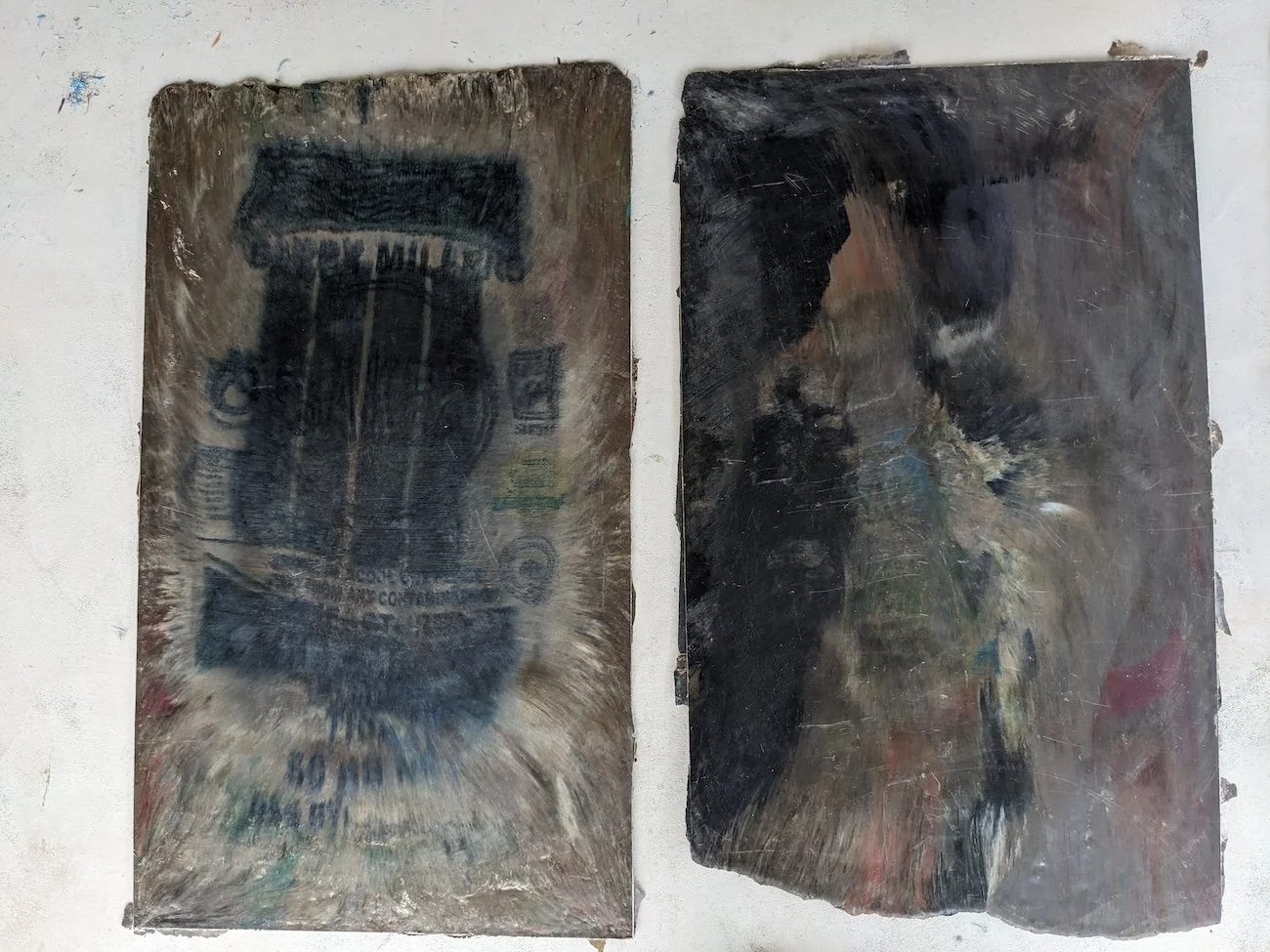
Magunia sheets made at Flipflopi HQ.
Magunia: a case study that demonstrates even materials that are the same are not the same!
One material deserves its own mention: magunia. These are woven plastic sacks (a mix of PP and BOPP) used everywhere in Kenya to carry everything from cement to charcoal. They're a hard material to work with — low value, bulky relative to weight, often contaminated with cement dust or calcium carbonate filler, and quick to break down into microplastic once left out in the sun. Plus there is no standard manufacturing process meaning that no 2 gunia are the same.
A research collaboration with TU Delft, run through the SMEP programme, spent time mapping how we could work with this material testing out different approaches and trying to find an industry standard.
We found running magunia through an agglomerator (the machine typically used to reduce bulky soft plastics before extrusion) is slow, noisy, requires a highly skilled operator, and tends to melt the material into a single, discoloured lump if it runs even slightly too long or too hot. However, when we press magunia directly into sheets we have better results as they form sturdy HDPE, LDPE and PP sheets, without the volume bottleneck agglomeration creates. Their proposal for scaling this up — a larger sheet press capable of handling around 34kg of magunia per sheet — is exactly the kind of practical, materials-first thinking we want more of in this space.
Read the full report here: JUMP x Flipflopi — Magunia Recycling Report
A simple guideline for testing materials
Before any new material is approved for our production line, it goes through the same basic protocol:
Visual and textural identification: colour, stiffness, whether it's braided or flat-stranded, translucent or opaque.
A density test — small samples are dropped into alcohol, water, vegetable oil and glycerin, and whether they float or sink in each narrows down the likely polymer family (a piece that sinks in water but floats in glycerin, for instance, points toward a different plastic than one that sinks in both).
A melting behaviour test in a modified oven, tracking the exact temperature range where the material goes flexible, where it melts smoothly, and where it starts to burn or degrade instead.
Once a material has a confirmed identity it moves to a production trial on our sheetpress or injection machine, where we test melting time, how easily it demoulds, and what the resulting output feels like.
Once material streams that pass this process, we figure out the throughput rates at the MRF to figure out the cost of collection and sorting allowing us to answer the question of if it’ worth collecting at scale.
320kg of ropes can be sorted, cut and cleaned by one person in a day
640kg of buoys crushed and washed in a day
Fishing nets take a long time to clean at around 33kg per person per day meaning as a material it cannot be processed efficiently at scale
For more information on what you can do to improve standardised recycling processes check out our toolkit.
Marine plastics: four materials, four different answers
Marine debris is its own category, because salt, sun and years in the water degrade plastic unpredictably, and a single haul can contain several polymer types tangled together and in different states of degradation.
Ropes turned out to be either polypropylene or nylon, distinguishable by feel (PP is stiffer and less reflective) and confirmed with the float test. Both process well on the sheetpress — PP at around 210°C, nylon slightly hotter — into sheets that are homogeneous, weldable, and hold up to bending and curving. Both have been released for limited production.
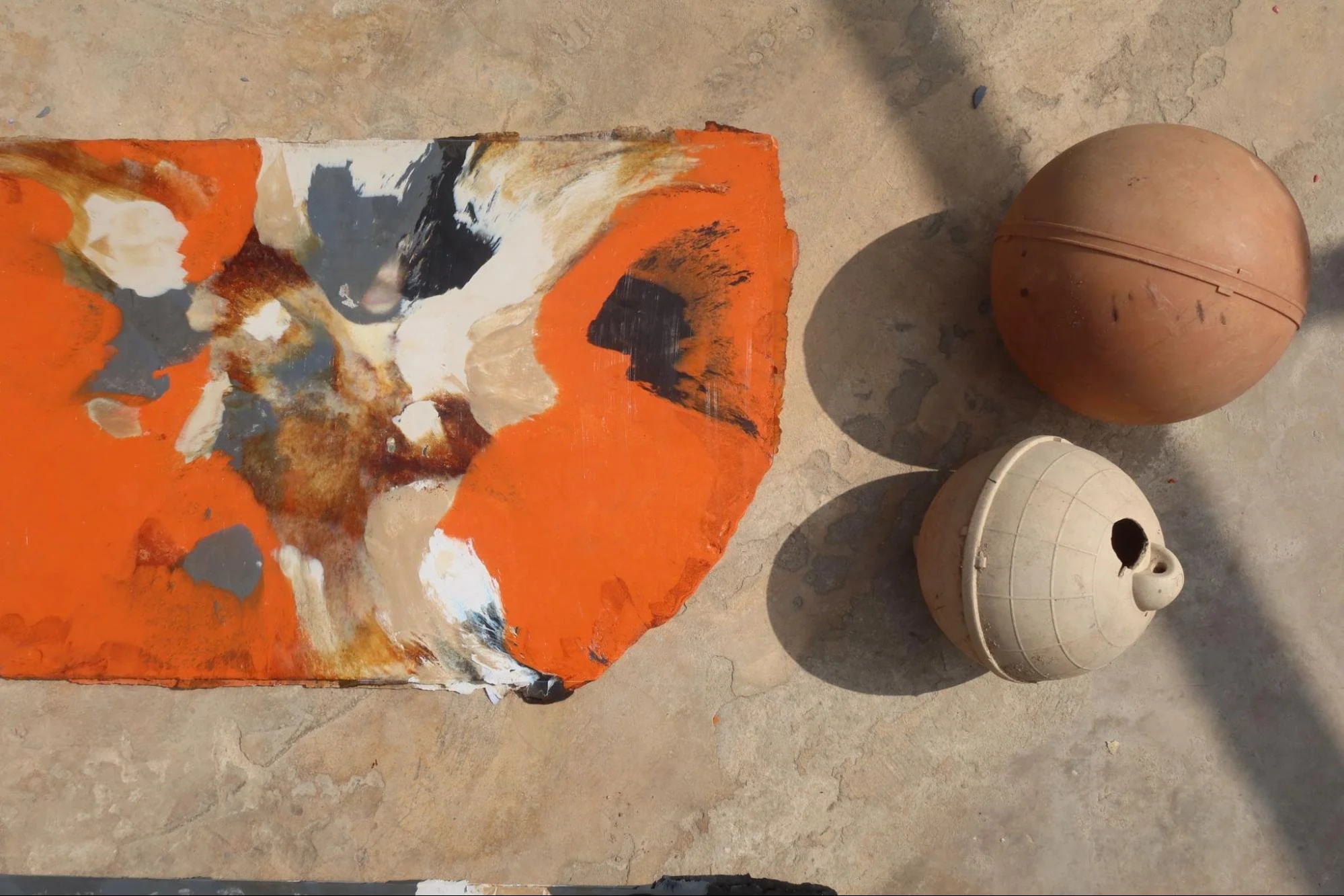
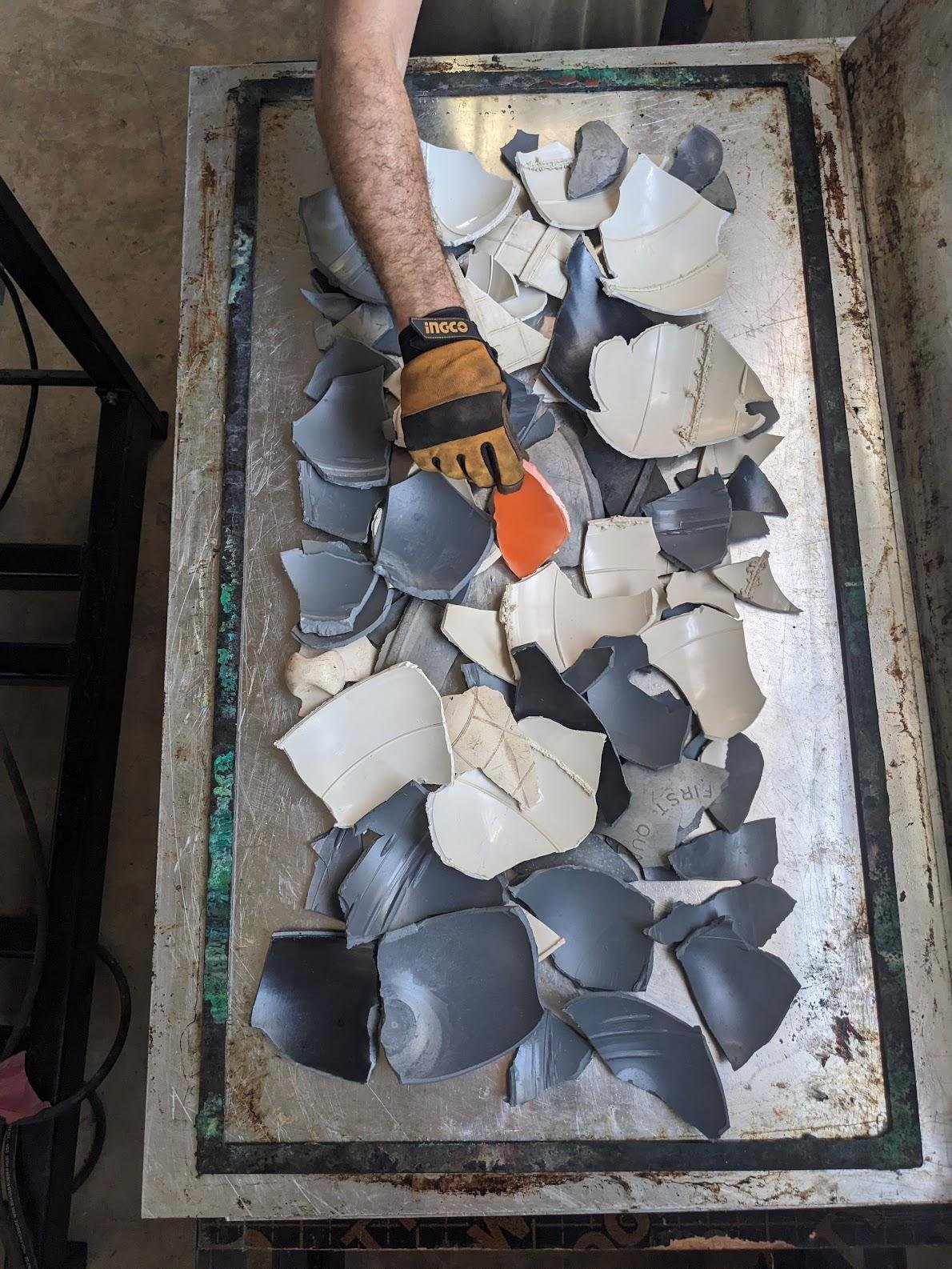
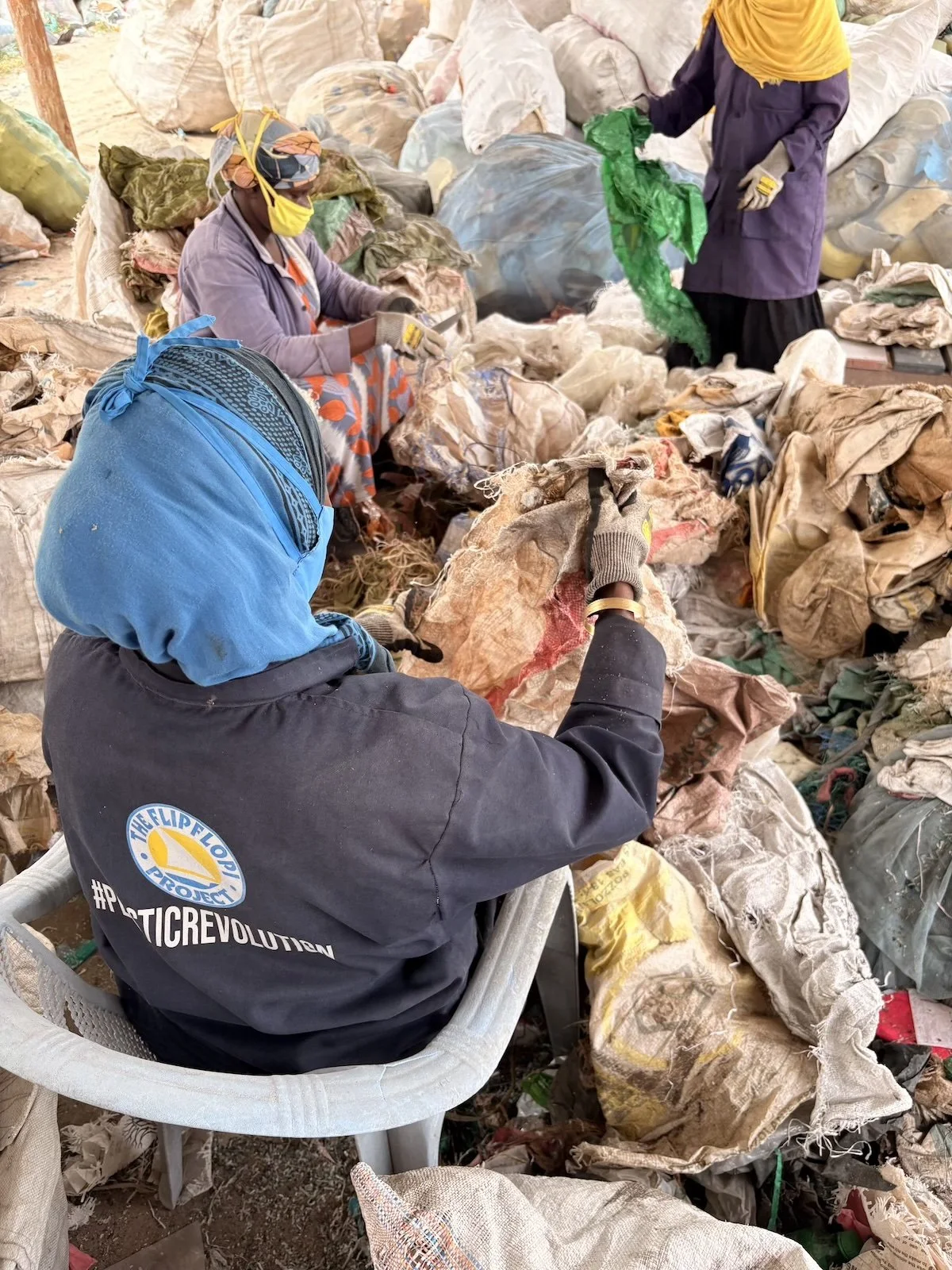
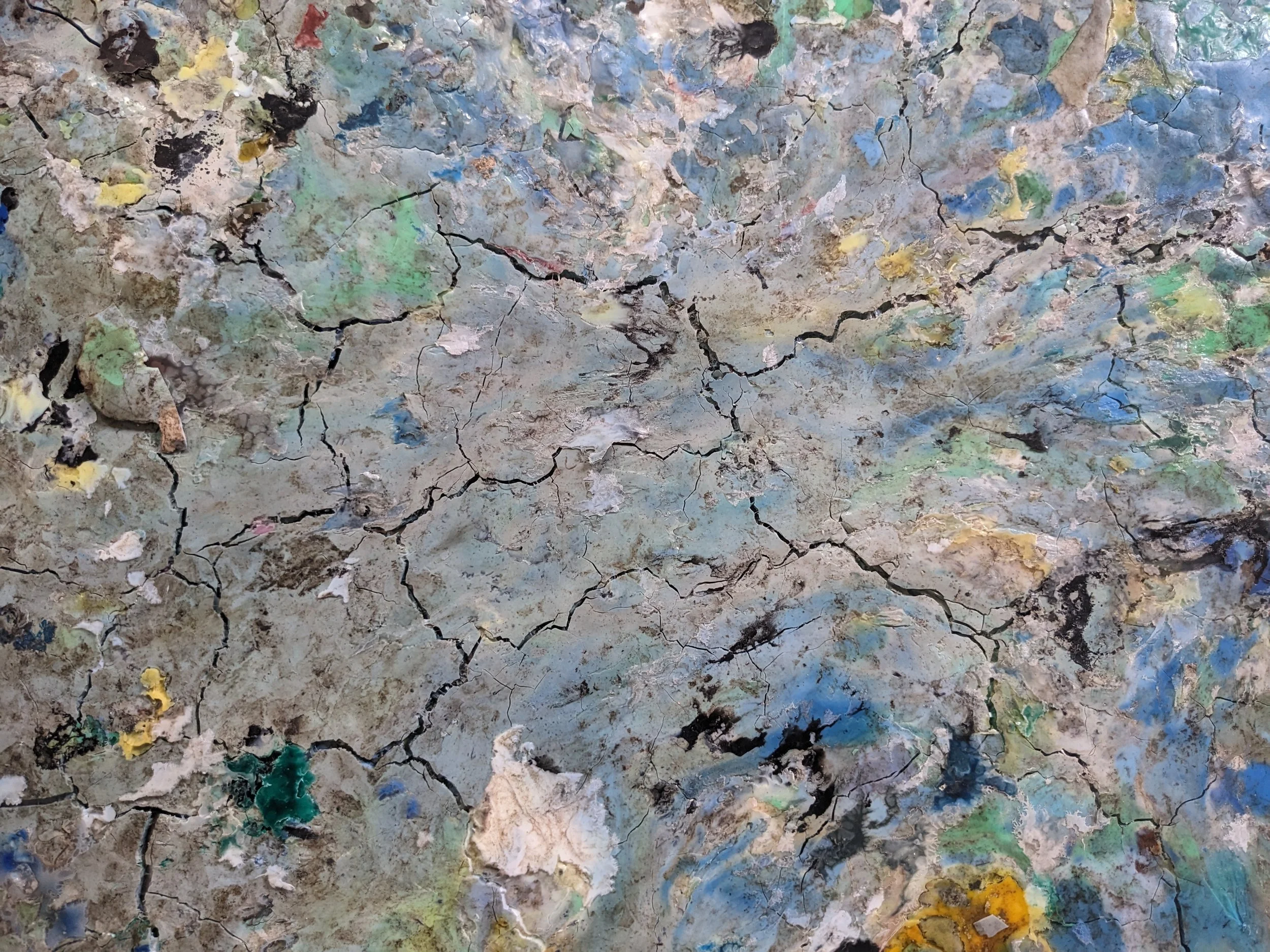
Buoys are ABS — denser than water, which is part of how we identify them, and tough enough that they need a hydraulic baler to crush rather than being crushed through our shredder. Pressed at 210°C, they produce a glossy, scratch-resistant sheet, though one that's less able to bend than rope sheet. Released for production.
Fishing nets are nylon, and the most labour-intensive material we work with — a fully rigged net, including ropes, floats and sinkers, is only about two-fifths actual recyclable nylon by weight, and separating that out is slow, manual work. Pressed around 230°C, the resulting sheet is translucent, flexible and tough, with sunlight passing through it in a way that's made it a strong candidate for lampshades and lighting appliances. Getting a full, evenly melted sheet from bulky net material is still an active challenge.
PET has been the hardest case, and remains unresolved. Repeated tests through 2025 and into 2026 — different temperatures, different drying methods, fast versus slow cooling — kept producing either a degraded, powdery black material or a glossy sheet that cracked as it cooled. The clearest improvement so far has come from using only clean, well-dried bottles at a higher, sustained temperature around 300°C with a slow cooling process, which has produced a more homogeneous, clearer result — but this is still active, ongoing research rather than a finished process.
The wider MRF: sorting the unidentified
Beyond marine debris, a batch of unidentified plastic waste pulled aside at the MRF was tested the same way: of 21 samples, 16 turned out to be ABS and workable on the sheetpress, 3 were not recyclable at all, and the remaining 2 showed properties closer to PP or HDPE.
Five styrofoam samples were tested the same way — only two behaved like true expanded polystyrene and could be melted into a dense block; the rest didn't melt cleanly and burned instead. Even where styrofoam is recyclable, its very low weight-to-volume ratio is flagged as an unresolved practical problem as it takes an enormous volume of it to fill a mould.
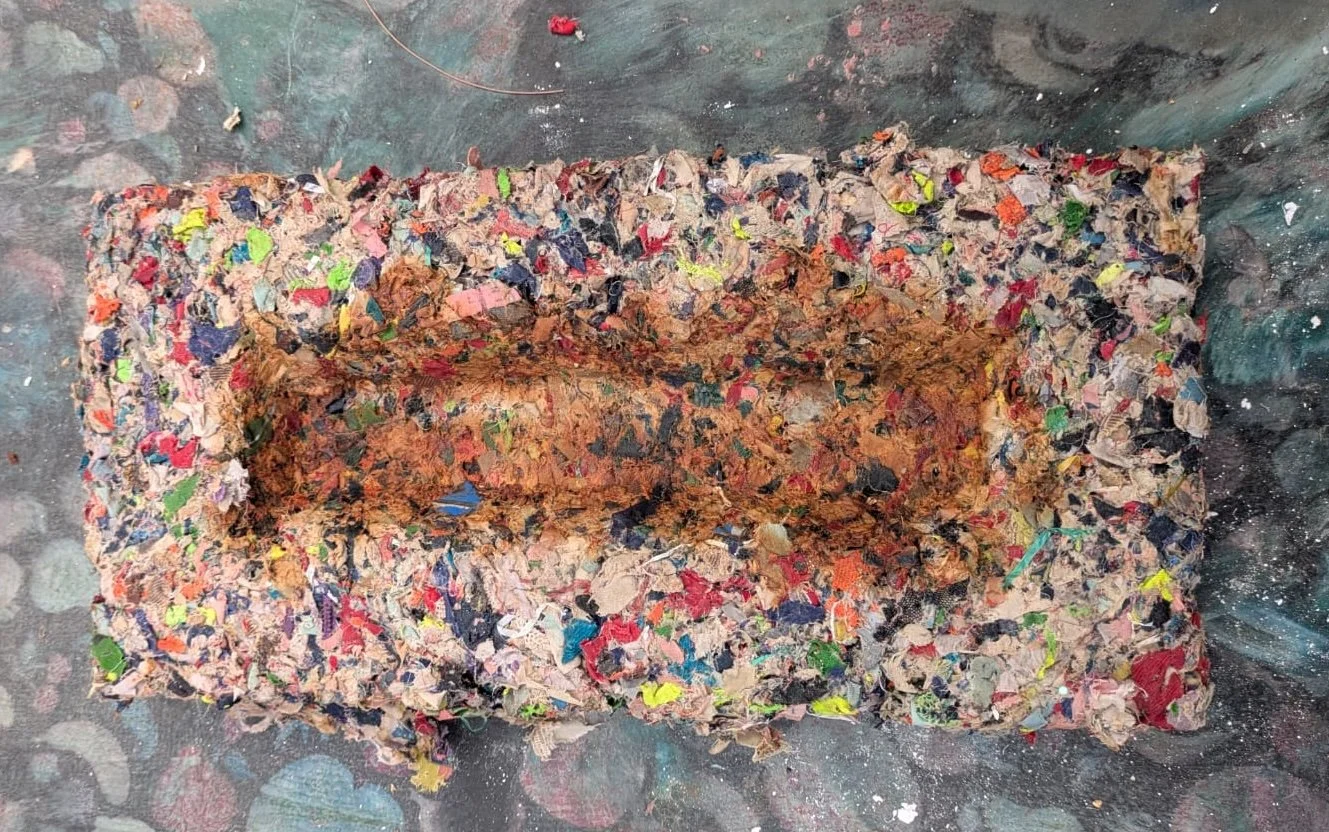
A prototype textile brick made during testing.
Textiles and non-plastic materials
Textile waste has had its own research thread, testing whether shredded fabric can be compressed into board material using binders like starch, gypsum, and PVA glue at different ratios.
Most combinations failed to produce something durable enough to use — but a starch binder with a small addition of PVA glue has produced the best strength and surface quality so far. It's very far off from becoming a finished product, but it's a priority area of research into whether the same waste stream choking Lamu's mangroves can be turned into something with commercial value here rather than disposed of.
Textiles are complex materials and are going to need significant dedicated resources to figure this out. The world is finally waking up to these environmental catastrophes that we cover our bodies with daily. Read more about our research into textiles in last year's blog; Fast Fashion’s Hidden Graveyard.
Non-woven PP shopping bags (locally known as Uhuru bags) are what replaced the single use plastic bags when they were banned in 2017. However, manufacturers of these uhuru bags have a lot to answer for in terms of their ostensible reusability as they often tear after limited use.
When recycling these however, we’ve been able to create a smooth, multicoloured sheet at 220° C. They were approved for community collection, with clear guidance for collectors on what condition bags need to be in (rejecting anything contaminated with cement or paint that can't be washed clean).
And we are barely beginning to even scratch the surface of nappies — the mix of plastics, absorbent gel and contamination makes them a genuinely difficult material to recycle by any process we currently have.
Doing this the only way we can
Every verdict from this process is a decision about what qualifies under our Verified Plastic Unit Recovery programme. Based on what our production line can turn into a product, what stays inside Lamu's economy rather than leaving it, and, when a material fails every test we have, what's left with nowhere to go but the environment, a fire, or a landfill. That last outcome is the one that breaks our hearts every time.
Even then, we'd rather find any legitimate route to keep a material out of the environment, including shipping it off to an offtaker elsewhere, than let it end up there. But economics rarely makes that possible. Prices for lower-grade recycled material are extremely low, moving anything off an island is expensive by definition, and the subsidies available barely scratch the surface of what this actually costs to do properly. If a circular economy is going to mean anything, it has to work in places like this — not only where the infrastructure and economies of scale already exist.
Kenya has made real progress on this front, but there's still a long way to go. You don't need to try, and fail, to recycle a nappy in a place as remote as Lamu to know that the product itself needs a complete redesign. If it doesn't get one, we can say with some confidence that nappies are on track to become Kenya's newest wildflower — blooming across every mangrove branch in the archipelago.