Flipflopi Impact
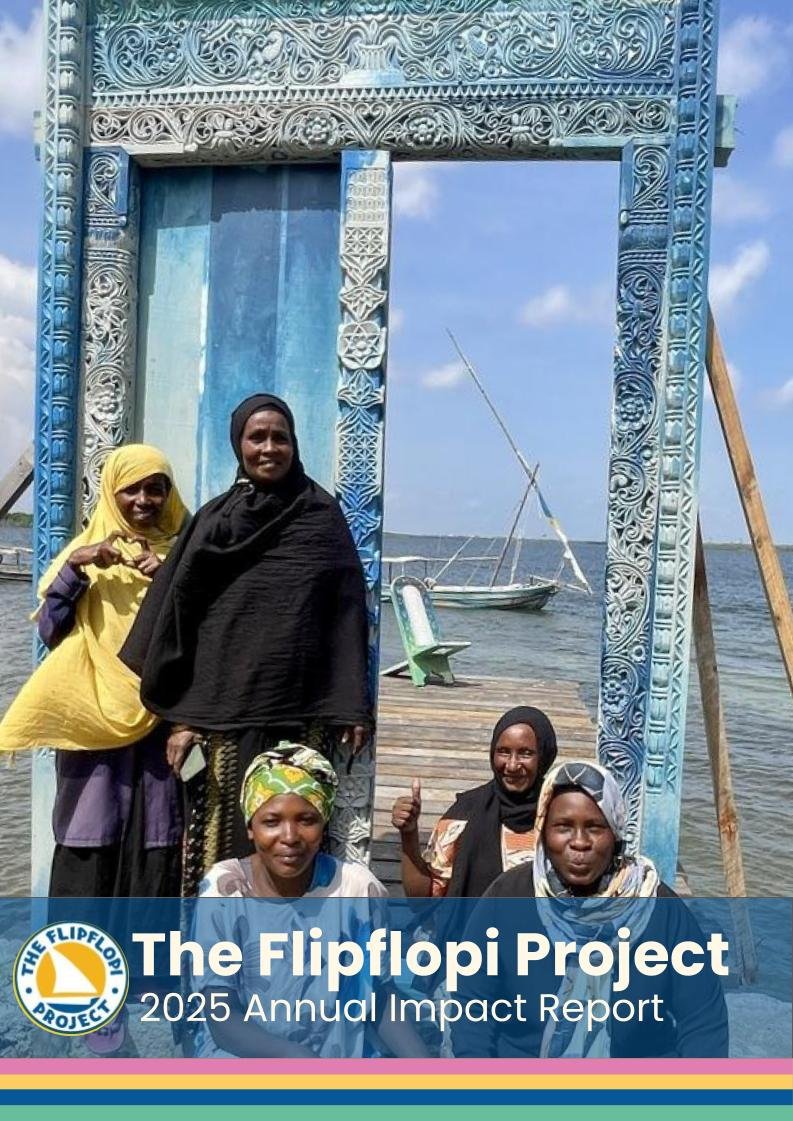
The argument at the heart of Flipflopi's 2025 Annual Impact Report is one ten years in the making: you cannot end plastic pollution without changing the system that produces it.
Ten years ago, we set out to prove that single-use plastic doesn't make sense — building the world's first fully recycled plastic sailing dhow and taking the #PlasticRevolution on expeditions across East Africa. In 2022, awareness turned into the next chapter of action: a community-owned circular economy in Lamu that recovers plastic, recycles it locally, and keeps the value with the people who make the system work.
In our years of operation, we’ve built tangible evidence to show that plastic pollution is a symptom of our economic system that externalises cost onto the communities least able to absorb it. Dominant circular economy models risk compounding this. Too often they are capital-intensive, volume-driven, and designed for scale - not for the people and places that need them most.
Solving plastic pollution can indeed be a gateway to transforming the systems that produce it but that has to be grounded in practical and tangible actions that directly benefit the people and ecosystem that are most affected by it on a daily basis. And this is what we are most proud of and keeps us going.
You can read the full honest version in the report: what's still hard about building enterprises where poverty is immediate, and why 76% of what we pull out of Siyu's mangroves isn't “plastic” at all — it's clothing.

2023 Annual Impact Report

2022 Annual Impact Report

2024 Annual Impact Report

2021 Annual Impact Report
Stubborn Optimism
In 2016 we set out to build a +20mts traditional lateen sailing dhow made entirely from recycled plastics on Lamu Island, a UNESCO World Heritage Site, off the coast of Kenya.
Not surprisingly we failed...but we did succeed to build a 9mt dhow made from 10 tons of recycled plastics - which was the first of its kind globally.
Flipflopi Ndogo (Swahili for "Small") has sailed across East African waters in land and on the ocean, garnering recognition as "Africa's Blue Planet Moment". That was just the beginning...and the journey begins exactly where we started: to build a 24mt dhow made from waste plastic lumber which will weigh over 60 tons. The building of this dhow and the subsequent expeditions across the globe will be the manifestation of systemic change, one that leaves no one behind - this is our mission: this is a Plastic Revolution.

Educate
Teaching practical circular economy skills and preserving indigenous skills at our Heritage Training Centre. 213 youth attended courses ranging from 5 days to 3mths. 40% participants females including Lamu’s first artisanal boat builders
Our first expedition led to an audience reach of 850million via media coverage (Independent Media Reports from UNEP)
3 sailing expeditions covering 2500 km, directly engaged 20,000+ in just 10 weeks including policy-makers, businesses and schoolchildren
Over 10,000 children reached through tailored education programs

Innovate
Built the world’s first recycled plastic sailing dhow and undertook three expeditions including Lake Victoria
Established first-of-its-kind plastic recovery centre and recycling facility for Lamu County serving 70% of the archipelago population
Recovered 400,000 kg of plastics and continue to collect an average of 10-12 tons a month
70+ sustainable heritage products developed with +50,000£ generated in product trials
Avoided 389 tCO2e in GHG emissions
Independent study ranked our model as having the highest health gain of all assessed projects
20% reduction in recyclable-plastics at local dumpsites

Influence
Initiated an East African Campaign to advocate for a ban of unnecessary SUPs and published a draft Bill together with Africa Legal Network
2024: Bill accepted for tabling in the EA Legislative Assembly
2021: Flipflopi model included as case study for good practice in Kenya’s First National Marine Litter Action Plan
2022: Included in Lamu Municipality’s First Solid Waste Management Policy as a key stakeholder
2019: Flipflopi was visited by the President of Kenya at the United Nations Environment Assembly and became a flagship symbol calling for a regional end to SUPs

‘‘We cannot afford to wait for others to stand up for our environment – as nobody stands to lose more than we do. It is our duty to be proactive in the battle to protect Africa's natural environment. The right to a healthy environment is a crucial human right because it directly impacts our quality of life.’’
— Nelson Mandela