Closing the Loop on Pate Island
What Does a Circular Economy Look Like on a Remote Island?
Pate Island is in the Lamu Archipelago off the northern Kenyan coast where small-scale fishers have depended on the same reefs, mangroves and fishing grounds for generations. There is little awareness of the harms of plastic pollution here. There certainly isn’t any kind of municipal waste collection here. So plastic accumulates in pockets throughout the island and if it isn't burned or buried, it will end up in the ocean. And once there, it threatens the same fisheries these communities rely on.
For the past few years, we've been working to change that and last year, we established an island wide system to integrate recovery firmly within our operating range. In partnership with CORDIO East Africa and thanks to support from the UK International Development-funded OCEAN Grants Programme and the International Fund for Animal Welfare (IFAW) the Flipflopi Project has been building a community-owned plastic recovery system across five Beach Management Unit (BMU) areas on Pate Island: Mtangawanda, Pate Village, Shanga Ishakani, Shanga Rubu, and Kizingitini.
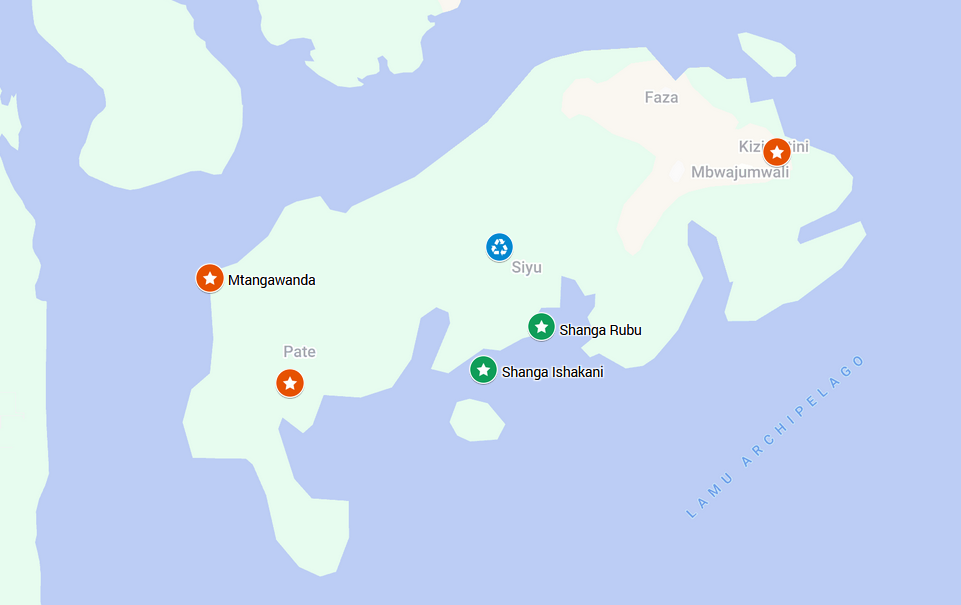
A map of Pate Island, the red stars are where our transit stations are based, the green stars are villages that are collecting plastic, and the blue recycling sign is where our MRF is based.
This is the story of what the first year of that work looked like.
18.1 Tonnes of Plastic Collected and What This Means
Between August 2025 and March 2026, communities across Pate Island collected 18.1 tonnes of plastic — an average of 2.26 tonnes per month.
Of that total, approximately 9.2 tonnes is estimated to have been recovered directly from marine environments such as beaches, mangroves, and the ocean itself. The rest came from households and town areas, intercepted and managed before it could reach the water, be burnt or buried.
These collections have been made by community members, including; local fishers, women's groups, youth groups, and community members who bring sorted plastic to transit stations in their villages, weigh it, and receive a payment per kilogram through our Repurpose Verified Plastic Recovery Unit (VPRU) subsidy. This system is similar to how we run our collections across Lamu Island where our HQ is. We have kept it simple and easy to manage because with that, we get more people signing on and collecting more wasted plastics.
During this time, we created a centralised Material Recovery Facility (MRF) in Siyu where we have a solid foundation of activities thanks to our partnership with CMA CGM. This is where PET and yellow HDPE is baled using an industrial baler powered by a secured three-phase KPLC electricity connection. The rest of the materials cannot be baled as hard plastics become too fragmented and therefore very difficult to differentiate between PP and HDPE. The plastic then travels by trike to Mtangawanda. Ten barge trips carrying 12 tonnes have already made that journey. Thanks to the baler, it has become more cost effective as we can transport much larger quantities in the limited carrying space.
Measuring What's Actually Out There: Our Marine Litter Surveys
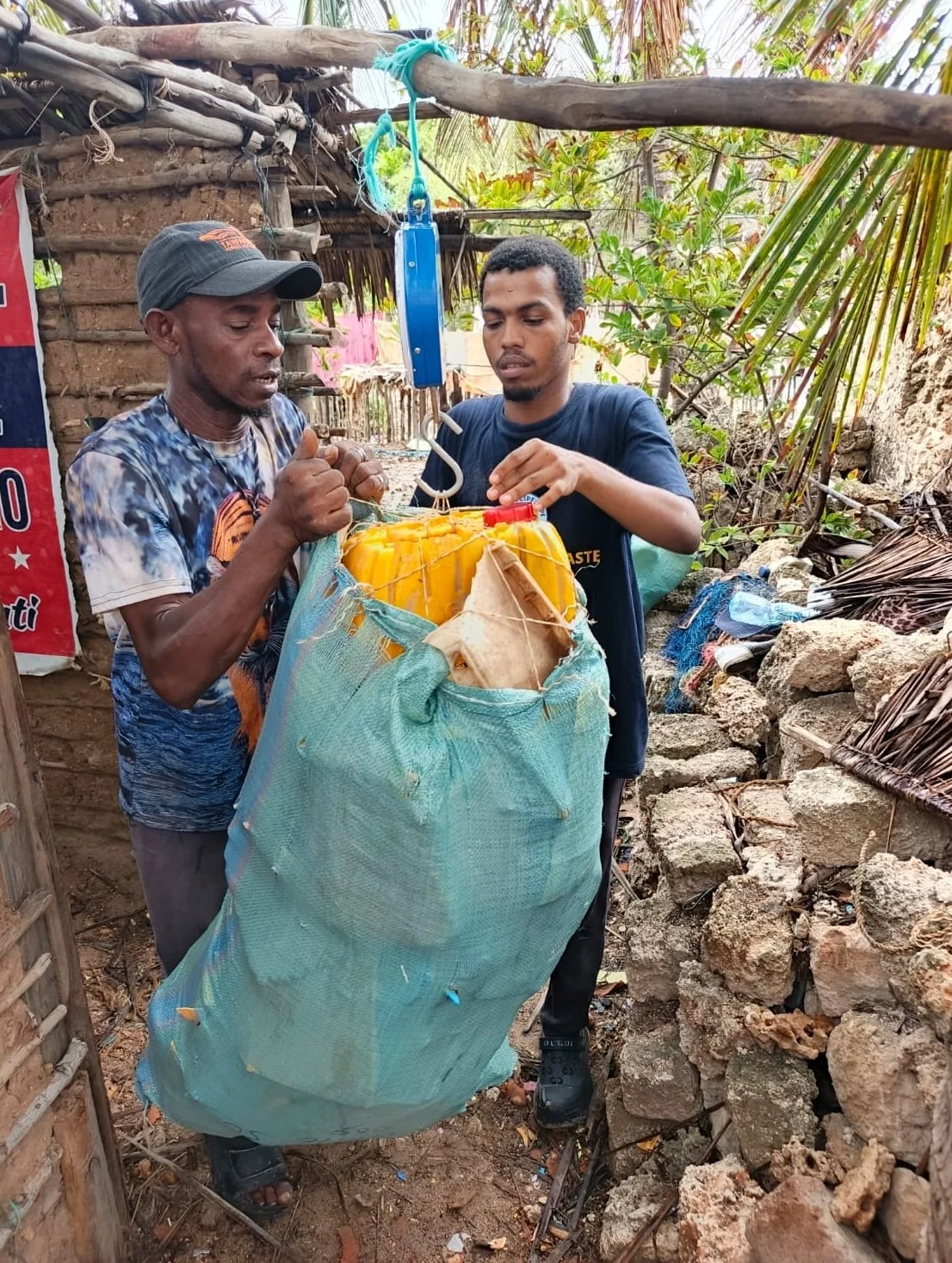
As part of this project, we wanted to understand more about the waste that is accumulating. Where are the hotspots? How quickly is it coming? What are the most common materials?
To monitor this we have continued running marine litter accumulation surveys across four sites on Pate Island, co-funded by OCEAN Grants and WIOMSA, covering two beaches (Kizingitini and Pate Village) and two mangrove sites (Mtangawanda and Shanga Ishakani).
Each survey begins with a full clean-up of all macro-litter at Day 0, then tracks everything that accumulates over the following seven days, mobilising up to ten community members per site.
The first survey, conducted in June 2025 and since approved by WIOMSA, found 16,187 pieces of marine macro-litter across the four sites in a single week. 64% was plastic; 21% was clothing (which is also mostly plastic!). On average, 25 pieces of macro-litter accumulate every day per 100 square metres — with mangrove sites collecting at nearly three times the rate of beaches (50 items per day versus 19). The most common plastic items were large fragments, lids and caps, ropes, and wrappers.
Five surveys are planned across the life of the project, timed to capture different seasonal and current patterns. Analysis of the November 2025 and February 2026 surveys is currently underway.
How Changing the Price Turbocharged Collections
For the first months of the programme, collections were frustratingly inconsistent. We were paying 10 KSh per kilogram for hard plastic and 5 Ksh for PET and flexibles like fishing rope. Pricing was set lower than we wanted because there were so many unknowns in terms of other logistical costs which are significantly higher on an island especially when there is no existing waste management systems in place. While some community members were engaging, participation was patchy and volumes fell well short of our monthly targets.
In February 2026, we raised the prices across the board — hard plastic to 16 KSh and PET to 11 Ksh per kilogram, nets to 6 KSh, and ropes to 11 KSh. The response was immediate. Within days, new suppliers appeared at transit stations. In a single collection session in Shanga Ishakani following the price increase, eleven people showed up to sell plastic for the first time. By March 2026, the project hit its monthly target of 3.3 tonnes.
The fishing gear numbers told the same story in sharper relief. By March 2026, Shanga Ishakani alone contributed 1.2 tonnes — including a full tonne of fishing ropes brought in directly by fishermen who had previously had refused to engage. Recovery is expensive and extremely time consuming and hard work removing the mess from mangroves and remote areas where it has been accumulating for years.
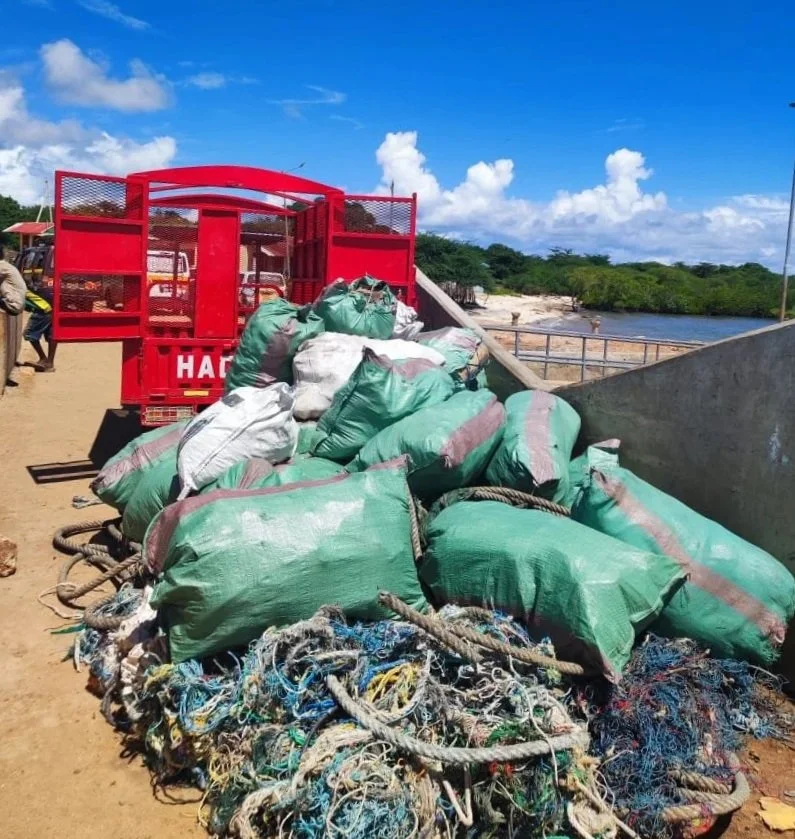
Tonnes of fishing rope and sacks of wasted plastics waiting to be loaded onto our barge for onward transport.
Fishing Gear Recovery: Closing a Gap That Others Have Flagged
Pate Island is home to an estimated 115 people or groups using beach seine nets. Beach seines are among the most destructive fishing methods in use: dragged along the seabed toward shore, their fine mesh captures everything in their path — juvenile fish, turtles, rays — while physically destroying the seagrass beds and coral reefs where fish live and breed. Studies on the Kenyan coast have found that over 70% of the catch from beach seines consists of juvenile fish that haven't yet had the chance to reproduce.
There has been significant efforts to reduce the use of beach seines in the area and as part of a separate gear exchange programme run by FFI and NRT, some fishers are transitioning away from these nets toward less destructive alternatives. But there was little follow up with what happened to the old gear. During this project, we found that most of it is just discarded, lost, or left to drift.
Our ocean plastic recycling work is designed to fill exactly that gap. R&D carried out at our Lamu facility has confirmed that PP marine ropes, nylon/PA fishing nets, and ABS buoys can all be processed through our machinery, producing high-quality sheets and planks with real commercial applications. These materials — previously considered too difficult to work with given costly recovery and first stage processing (separating, washing) — are now being incorporated into products. The fishing rope collected on Pate Island is being recycled on the same island chain, and returned to communities as durable goods.
KES 157,275 Distributed, Over 60% Going to Women
The buy-back scheme distributed KES 157,275 to 144 individuals and 9 community groups between August 2025 and March 2026. Sixty percent of individual participants were women.
Women's groups have been among the most active participants across all five BMU areas. The Mtangawanda Mangrove Restoration CBO organised and led one of three pilot ocean clean-ups in February 2026. The Mpaji Women Group in Kizingitini — comprising 17 women, including five young people — has been receiving targeted business support, including help establishing a Village Savings and Loan Association (VSLA) and training in conservation enterprise. The group is now supplying plastic to the transit station while also building its own financial resilience.
One of the project's strongest inclusion outcomes involves the Pate Disabled Self Health Group, which has made nine supply trips since February 2026, recovering nearly 600 kg of plastic and earning KES 7,973 in direct payments. Proactive outreach where the community lead has visited the group, explained the scheme, and adapted logistics to make participation practical which has made all the difference.
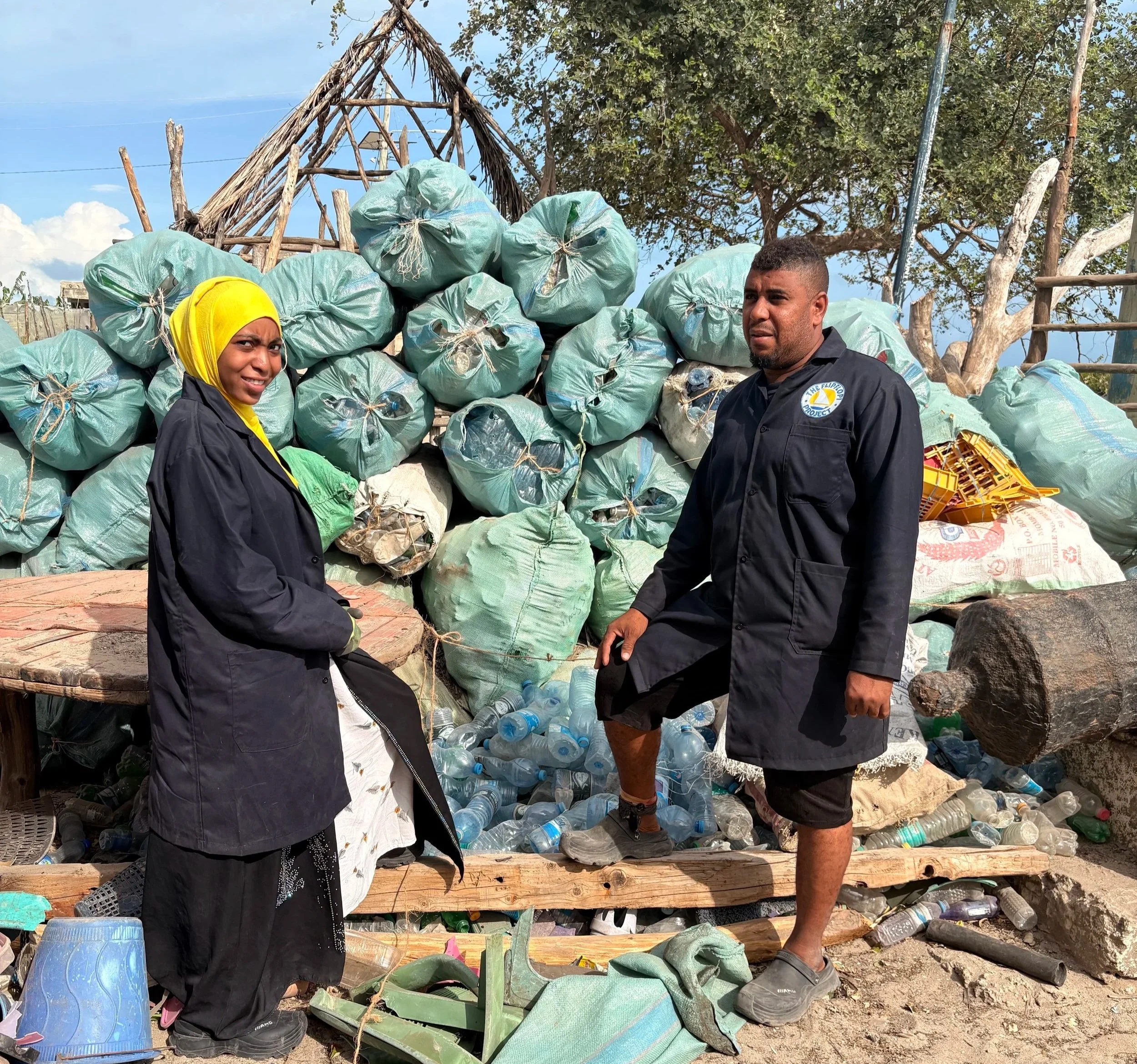
Our Pate Village team have taken a strong lead in showing how integrated plastic recovery can work
Communities as SUPPLIERS, Customers, and Builders
One of the best things we’ve seen out of this project is where some of our suppliers have become customers as they invest in our long lasting, sustainable materials to build with.
PRATI, a community enterprise and fishing initiative in Pate Town operates a community restaurant. They built their restaurant just above their transit station partly using recycled plastic sheets from the Flipflopi production facility. Plus, they're super keen to place an order for a further six recycled plastic tables and ten plastic sheets and they’ll be settling part of their bill in wasted plastics.
Meanwhile, the Mtangawanda Mangrove Restoration CBO has earmarked KES 30,000 to purchase Flipflopi recycled plastic planks for a community boardwalk through the mangroves replacing wood with ocean plastic, and linking conservation directly to livelihoods.
Building BMU Governance From the Ground Up
To make this project sustainable and to last beyond the funding timeline, the goal is to integrate recovery into Beach Management Units. BMUs are legally mandated to manage fisheries and coastal resources across Kenya, however, their governance structures are not always up to scratch for the mammoth task they have to manage.
This is where we brought in our colleagues CORDIO East Africa to deliver a comprehensive governance and capacity-building programme across five BMUs, including a rapid assessment using the SAGE governance framework, leadership and governance training for 50 BMU members, and a five-day peer-to-peer learning exchange in Kwale and Kilifi Counties. 166 community members participated in a sustainable fishing practices awareness campaign.
To also incentivise BMU to integrate recovery, we introduced a levy of KES 1 per kilogram of plastic collected. To date, this has accumulated KES 15,837 across five BMUs where we hope it will be used as a financing mechanism for future clean-up activities. MOUs are being finalised to formalise how these funds will be used, with BMU assemblies already debating the options in their own meetings. Bottom-line is displaced plastics are significantly more expensive to close the loop on and without appropriate subsidies through various Polluter Pays Principles such as the EPR and a multi-stakeholder approach, sustainability will remain challenging at best.
A whole host of complex challenges remain including financial autonomy and management. Tax collection from fishers — long-mandated but rarely enforced — remains inconsistent, constraining the financial autonomy these institutions need to act on their own mandate. These are structural issues rooted in the absence of strong governance, not ones the project alone can resolve, but we hope we can be part of the solution.
What Year Two Looks Like
The project runs until March 2027. In the coming year, the focus turns to expanding collection networks, completing marine litter accumulation surveys across all five BMU areas, and developing knowledge documents to share what's been learned with other coastal communities facing similar challenges.
The model is working. The question now is how far it can go — and who else it can bring in.
If you want to follow the work below, or follow us on Instagram and LinkedIn.
The Flipflopi Project Foundation is implementing this project in partnership with CORDIO East Africa, with support from the International Fund for Animal Welfare and the OCEAN Grants Programme funded by UK International Development.