Beyond the Boat, Beyond the Ban: How Flipflopi is Driving East Africa's Historic Plastic Legislation
Ten years ago, we had the dream of building a boat from what people throw away. And through grit, determination and a heap of trial and error, we created it. 10-tonnes of plastic collected from beaches and communities along the Kenyan coast transformed into a traditional vessel. A vessel that has become one of the most recognisable symbols of the fight against plastic pollution on the continent.
But Flipflopi advocacy was never just about the boat.
From the moment Ndogo was launched, the mission was clear: use the power of story, symbol, and community to drive the kind of systemic change that a beach clean-up alone could never achieve. Today, more than a decade of relentless grassroots advocacy is on the cusp of delivering something historic — a unified regional plastic legislation framework for Africa that would end single-use plastics in East Africa across the region. This is the story of how we got here, where we stand today, and what comes next.
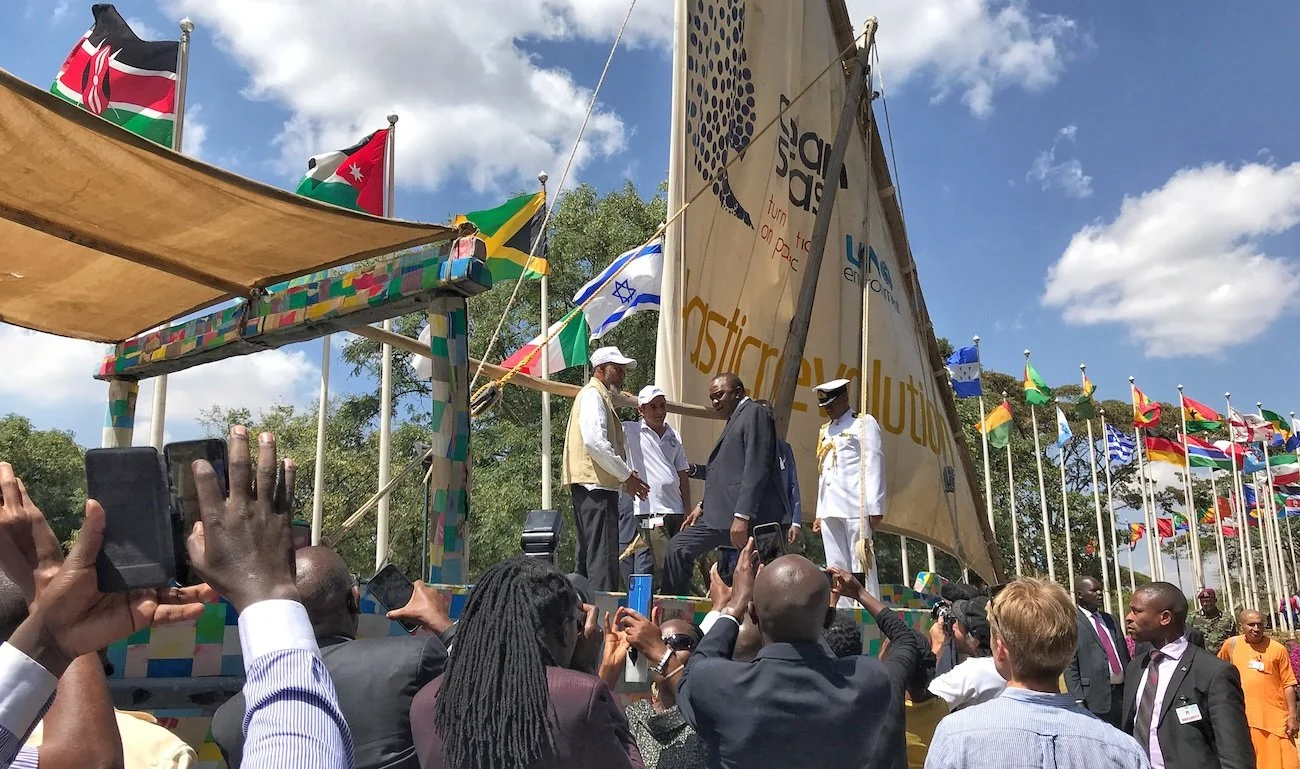
Former Kenyan President Kenyatta on board the Flipflopi Dhow at UNEA 4.
The Problem with Going It Alone
Kenya made global headlines in 2017 when it introduced one of the world's strictest plastic carrier bag bans — a landmark moment championed by Prof. Amb. Judi Wakhungu, then Kenya's Minister for Environment and a longstanding member of Flipflopi's Advisory Board. It was bold, it was brave, and it was necessary.
But it also revealed something important: national action alone is not enough.
The plastic industry produces at least 232 million tonnes of planet-warming emissions every year. Microplastics have been found in human breast milk, the Arctic Circle, and the floor of Lake Victoria. The scale of the problem is vast — but so is the momentum behind the solution.
For every piece of plastic picked up on a Kenyan beach, the ocean tide brings in five new pieces. Plastic doesn't stop at borders. It flows freely across the shared waterways of East Africa — down rivers, across Lake Victoria, and out into the Indian Ocean. Studies in Lake Victoria found that 1 in 5 Nile perch contain plastics, and that the highest concentrations of microplastics were found on the Ugandan side of the lake, where plastic bag bans had not been fully implemented. The data made the case plainly: where one country acts and its neighbours don't, the problem doesn't go away, it just flows downstream.
Early attempts to address this at the East African Community (EAC) level — including proposed Polythene Materials Control Bills in 2011 and again in 2016–17 — stalled in the face of private sector opposition and political complexity. The political will existed. The coordination did not. Yet those early efforts were not wasted. They established a foundation, and confirmed that a regional solution was not only desirable but essential.
From a Dhow to a Draft Bill
In February 2021, Flipflopi launched a regional petition calling on all EAC member states to adopt harmonised legislation to end unnecessary single-use plastics in East Africa. This included items like plastic cutlery, disposable cups, cotton buds, and straws that cannot be recycled and are non-essential to human survival.
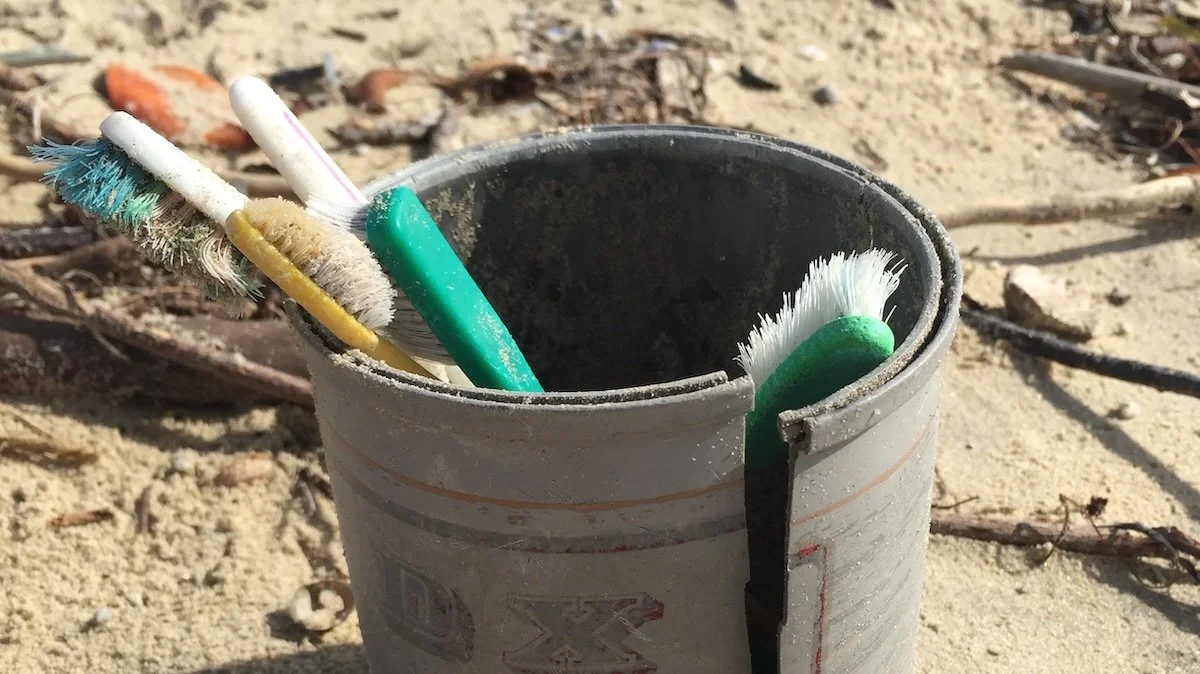
Toothbrushes found during a beach clean up - one of the most common things found on beaches.
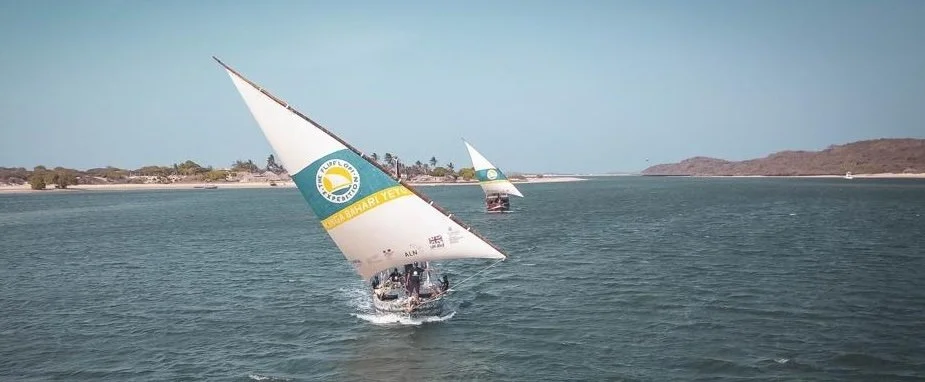
The petition was backed by action. In March and April of that year, the Flipflopi Ndogo led a major expedition across Kenya, Tanzania, and Uganda, convening government representatives, business leaders, conservationists, community members, and schoolchildren to shine a spotlight on plastic pollution in Lake Victoria. Like the Clean Seas expedition before it, the Lake Victoria journey demonstrated what makes Flipflopi's approach distinctive: by using locally resonant narratives and a cultural symbol turns awareness into action.
The results from both expeditions were tangible. The Queen of Buganda publicly endorsed the proposed ban of unnecessary SUPs across the EAC and her home Country, Uganda became the first landlocked country to sign UNEP's Clean Seas Commitment. Over 30 hotels along the Kenyan coast introduced single-use plastic bans. Youth parliamentarians from all seven EAC member states brought forward a motion urging regional legislative action. Communities that had never engaged with plastic policy before were part of the conversation.
But Flipflopi also knew that grassroots momentum needed to be matched by legal precision. That's why the partnership with ALN Kenya, East Africa's largest full-service law firm, was so significant. Together, Flipflopi and ALN co-developed the East African Community Single-Use Plastics Bill — the first regional legal framework designed to harmonise plastic management across the EAC. The Bill was drafted through extensive stakeholder consultation, presented to the EAC Legislative Assembly (EALA) in 2022, and timed to coincide with a pivotal global moment: the UN Environment Assembly's agreement to begin negotiations on a legally binding global plastics treaty.
East Africa was not watching from the sidelines. It was helping shape the future.
Building the Coalition
A good bill alone doesn't become law. What followed was years of painstaking coalition-building, technical strengthening, and regional diplomacy.
In April 2023, an East Africa Regional Workshop convened 21 Members of Parliament representing all seven EAC Partner States. The outcome: unanimous endorsement of a regional approach to tackling single-use plastics. Through partnerships with UNCTAD and the Sustainable Manufacturing and Environmental Pollution (SMEP) Programme, the Bill was stress-tested against international standards — on biodegradability, compostability, circular materials, and trade compliance — ensuring it was not just ambitious, but enforceable.
Led by Board Member, Carlotta Dal Lago, Flipflopi and ALN carried the message to global stages: the UNCTAD Ocean Forum, INC negotiations on the global plastics treaty, CHOGM in Rwanda, the Africities Conference in Kisumu, and the Africa Waste is Wealth Conference. In 2024, Flipflopi and ALN were accepted into the Business Coalition for a Global Plastics Treaty, convened by the Ellen MacArthur Foundation and WWF — joining over 200 businesses, financial institutions, and NGOs calling for an ambitious global treaty.
Critically, the private sector was brought into the process rather than left outside it. Between November 2024 and January 2025, ALN conducted a comprehensive consultation with manufacturers, business associations, recyclers, and regulators. Their feedback was incorporated into an updated draft of the Bill, making it more practical, more economically grounded, and harder to oppose.
In October 2025, ALN presented a formal legal opinion to EALA comparing the SUP Bill to the earlier, stalled Polythene Materials Control Bill. The conclusion was clear: the new Bill is far more comprehensive and enforceable. The House agreed and gave it unanimous support.
Where We Stand Today
On 15 October 2025, leave was granted to introduce the EAC SUP Bill as a Private Member's Bill at EALA — a designation that matters, because it means the Bill carries genuine democratic legitimacy and political ownership from elected representatives across the region.
The Bill has since been submitted to the Principal Legislative Draftsman and is now moving through its formal parliamentary journey. The first reading is expected at the March or June 2026 EALA sitting, followed by public hearings and regional consultations across all EAC Partner States, committee refinement, and a final vote. The target: passage by November 2026.
If successful, the EAC SUP Bill will be one of the world's first comprehensive regional legal frameworks specifically designed to address single-use plastics — placing East Africa alongside the European Union's landmark Packaging and Packaging Waste Regulation as a global benchmark for bold, enforceable environmental law.
As Dipesh Pabari Flipflopi's managing director put it: "After six years of relentless grassroots advocacy, it's incredible to see this gaining traction — born from the deck of a recycled plastic dhow made on a small island in the Indian Ocean."
The Journey Ahead
Passing the Bill will be a historic milestone. But it will not be the end of the journey.
Legislation is only effective if it is implemented and enforced. Once adopted, the work of domesticating the Bill into national frameworks across all seven EAC Partner States begins. In other words, translating regional law into enforceable national regulations, standards, and mechanisms. History has shown, including through Kenya's own experience with its plastic bag ban, that enforcement is where even strong laws can falter.
There is also the human dimension. Plastic regulation cannot succeed without the people who already manage so much of our waste — the informal waste workers who form the backbone of recycling economies across East Africa. In 2024, Flipflopi partnered with Systemiq and others to pilot a living income methodology for informal waste workers, because a just circular economy must work for people, not just for policy targets.
At the local level, Flipflopi continues to work with communities in Lamu and along the Kenyan coast, supporting the establishment of a Waste Management Consortium to fill the gaps that national and regional legislation alone cannot reach.
East Africa has an opportunity not just to respond to the global plastics crisis, but to lead the world's response to it. And Flipflopi — a boat made of old toothbrushes and flip flops, with a crew of activists, lawyers, scientists, and communities behind it — will be there every step of the way.
Want to be part of this journey? Follow our advocacy work, sign the petition, and share this story. Together, we can turn the tide on plastic pollution.